Interview with Alexander Ioffe. April 29, 2004.

Ioffe, Alexander. Moscow. Courtesy of Alexander Ioffe.
We are at Alexander Ioffe’s apartment in Haifa.
Yuli: Alec, first of a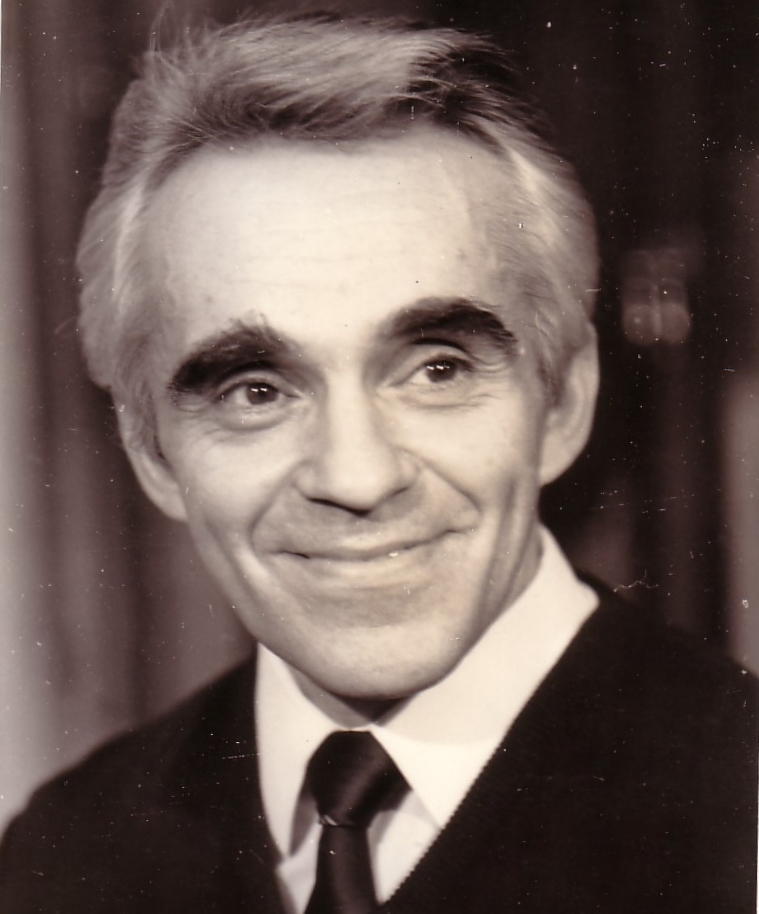
Alec: I was born on July 28th 1938 in Leningrad. Two months after this important event I became a resident of Moscow and I remained there until our emigration with a short break as a result of evacuation. We lived in the center of Moscow, not far from the Artillery Academy where my father taught.
Yuli: Where are your parents from?
Alec: My Father was born at a small railway station in a small village of Drabovo in the Ukraine. My Mother was born in a Jewish village of Ramny in the Poltavsky region. All this was inside the Pale of Settlement. My Mother’s family was very religious, and my Father’s parents were, on the contrary, quite emancipated. My Mother came from a big family. She had nine brothers and sisters. One of them died young; another was arrested for being a Zionist in the 30-s and disappeared; two of them were lost during the war; and the rest of the family moved to Leningrad and lived there. My parents were very young at the time of the Revolution and, therefore, they were naturally carried away by the revolution wave. My Father was an active Komsomol member since he was 16, and at the age of 18 he was already assigned to work as regional Komsomol Secretary precisely to the village where my mother lived, to Ramny. In 1925, at the age of 20, he went to Moscow to study at the Moscow Higher Technical College; there, too, he served as local Komsomol Secretary. Later, in 1930 there was a Party call-up to the Army, and he was sent to study at the Military Academy in Leningrad. He graduated from the Academy, defended his Ph.D. thesis and remained working at the Academy. Later, in 1938 the Academy was moved to Moscow and we moved with it and lived in Moscow ever after.
Yuli: He was 33 in 1938?
Alec: Yes…
Yuli: He was already a Ph.D. despite his stormy youth?
Alec: They had a lot of everything there… In 1925, my Mother went to Leningrad and studied at Teachers’ College (it was called “pedology” then); later this college was closed. She went to Urals to teach in the town of Irbit and three years later she returned to Leningrad.
Yuli: Did your father become a scientist?
Alec: My father’s biography is very complex and uneven. What did not fall in his lot! He began his career as a very capable engineer in the Academy. After the war he worked for a couple of years in the field of artillery guidance instruments, then he worked in Moscow at the Chief Artillery Authority – there it was not scientific work.
Yuli: Did he participate in the war?
Alec: He spent a lot of time at the front, but he was not in the fighting units. In 1949 he was expelled from the Party and from the Army, but not due to his being Jewish…
Yuli: There was this campaign against “cosmopolitans devoid of Motherland”…
Alec: No, his case was not part of this campaign. There was an internal campaign when a great number of officers were expelled. He was a Colonel, and most of them were Generals and Marshals. Generals and Marshals were arrested and imprisoned, and the Colonels were fired and expelled from the Party, but they were not arrested. The main character in that story was Marshal of Artillery Yakovlev. His son was later a teacher at the Academy. There was no organized campaign in the press. All the Colonels that were fired were ostracized. It was a small world there. Everyone knew everyone else, only the military lived in our building. On March 1, 1953, an order to evacuate the building was issued by the Army Prosecutor’s Office. We were not victims of the campaign against the Jewish physicians because the family belonged to the military. We were not physicians, but this was subject No. 1 of all conversations at that time. And the situation outdoors was terrible. At that time I learned I was Jewish.
Yuli: Did you try to understand the reasons for it at that time?
Alec: No, of course not! At that time?… God forbid…
Yuli: And later?
Alec: After I grew up many things became clearer. My parents did not tell me about what had happened to my father until I was 14. Of course, I understood that something was going on because my father stayed home a lot although he went out every day, probably in search of work. When I was 14, my older sister Inna told me what had happened.
Yuli Was your family completely assimilated?
Alec: Yes, with regard to anything that had to deal with us. Less so with regard to the parents, because my mother spoke very good Yiddish, my father too (although he used it less), and they used to go to the Yiddish theatre often. The next generation, i.e. we, were not interested in all that.
After Stalin’s death everything started to return to its original state. In the beginning of summer 1953, the decision regarding my Father’s expulsion from the Party was annulled. But he did not return to his old job. He was assigned a position of a military representative at a factory where he worked for two years until his retirement. After his retirement he found a very good job as head of a laboratory designing technical equipment for bio-electrical artificial limbs.
Yuli: Did he forever remain an orthodox Communist?
Alec: No, he did not but he loved his youth. There were many interesting things and he acquired lots of friends at that time.
Yuli Did he object to your Aliya?
Alec: Yes, he strongly objected. My mother died in 1974 before we applied for an exit permit, and he did not want us to apply. He did not want even to talk about it. It was too painful for him despite the fact that his uncle who taught Math at the Academy was executed in 1938.
Yuli: The name “Ioffe” is very famous in scientific circles. Academician Ioffe…
Alec: This was a very talented family. The Father of Abram Fedorovich Ioffe was as far as I understand my great-grandfather’s brother. But he was baptized, and the family split. He did not behave as our relative. We had many other relatives, and there were many prominent people among my father’s relatives. Sometimes they did show up in their quality of relatives, but Abram Fedorovich never did.
Yuli: Do you have only one sister?
Alec: Yes, but I have a number of cousins here. Anya Kholmyanskaya is my niece, the daughter of my cousin.
Yuli: I heard that her father, also, had an important job.
Alec: Not really. Our relationship with him was strained, too. At present he is in Israel, he is ill; I believe he has Parkinson’s disease. Two other female cousins live in Israel, but we almost do not meet.
Yuli: Who did your parents want you to be?
Alec: My father wanted me to be an engineer which was a big mistake. He pushed me to all kinds of engineering study groups, although it did not attract me in the least. As a result, I lost a lot of time.
Yuli: Did you finish a specialized school?
Alec: No, I went to an ordinary school. There were good teachers and good atmosphere in this school. The schools in the center of Moscow were good.
Yuli: Were you a good student?
Alec: I finished school with honors. The atmosphere there was very friendly and I am still grateful for that. I still have many friends I acquired in school.
Yuli: Did you discover an interest in Math in school?
Alec: Yes, but my father made a mistake here. He did not understand this interest and he suppressed it as much as he could. I entered the Moscow Aircrafts’ Institute and I soon realized it was boring. I had some interest in radio in theoretical aspects, but no interest whatsoever in instruments, equipment and so on. After my graduation I immediately entered the University, the evening Mathematical Department for engineers. At that time I already knew what I wanted. I started solving problems…
Yuli: You studied at MAI from 1955 till 1961, and you were at the University from 1961 till 1966…
Alec: Of course I was working at the same time…, in a “yashchik” (Yuli’s Note: A research and/or industrial company involved in activities directly or indirectly connected to the military. The work of such companies and the companies themselves were classified as secret, and instead of having regular titles they were labeled P.O. Boxes; “yashchik” means “box” in Russian). In 1967 I defended my Ph. D. thesis, on a semi-mathematical subject.
Yuli: When did you leave the “yashchik”?
Alec: In 1972.
Yuli: Did the Six Day War have any effect on you?
Alec: Of course… It was a remarkable event. By then we already understood the situation. We had read all the books, and talked about it a lot. But we still did not have a full sense of national identity.
Yuli: What about the terrible anti-Semitic propaganda that started after the 6 Day War?
Alec: It was disgusting, but who cares about the authorities? I did not have any special Jewish identity at that time. Undoubtedly, I had a general feeling of aversion to what was going on.. I refused to understand the system… In approximately 1971, I felt compelled to leave the Soviet Union as a result of feeling that it was impossible to live in that country any longer… Then there was the second day of the Yom Kippur War when I reacted very emotionally to a stupid remark made in the apartment of my old friend… It was another strong impulse, and next year, in 1974, we asked for an invitation from Israel.
Yuli: When did you begin to participate in the work of the seminars?
Alec: I came to Alexander Lerner’s seminar approximately in 1972. In 1975 I presented a report at his seminar. Then I presented another report at Alexander Voronel’s seminar. Lerner’s seminar had a political tinge to a considerable degree, while Voronel’s seminar was more of a scientific activity. Although no two scientists at our seminar belonged to the same field of science, the seminar played a positive role in my life. Due to this seminar, I succeeded to remain in science. I was lucky, to a considerable extent thanks to my French colleagues – I was not completely fired. The Rector of the Road Institute where I worked proved to be a decent person (as far as a rector of a higher education institution could afford to be). He removed me from the lecturers’ group, and I was not allowed to teach, but I still remained a senior staff scientist. He was, also, a car race fan, and the office of the Car Racing Federation was headquartered in Paris where my colleague and good friend Jean Pierre Rodin lived. I told him about my situation and he said he will talk to him and he did. Once “The Committee of Concerned Scientists” sent me an invitation to a conference. The embassy responded that I could not attend because I was very busy at work. Jean Pierre showed this response to my Rector and said: “If you fire him now, we in the West will raise hell”. And I kept my job. At first they made me come to the office every day and recorded the hours, but later…
Yuli: Were your articles published in the West?
Alec: Yes, in the end of the ‘60s and in the ‘70s, I had some good articles published and I also participated in several All-Union conferences. I was not allowed to meet with foreigners because of my access to classified information, but I wrote something… and I participated. I worked in the Math department, which is theory, but at some point I had 1st degree access.
Yuli: Did you work until your last day in the country?
Alec: I worked till my last day in that country!
Yuli: But you found the time to participate in the seminars, the refuseniks’ activities, and Mashka’s work… What was your transition to the refuseniks’ life like?
Alec: I started to be involved in refusenik life as early as in 1971. We all had friends. I attended Rubin’s seminar, but after I left the “yachik” …in 1972. It happened relatively late, but, at first, I could not find my place. At that time I could not afford to quit and remain unemployed.
Yuli: When did you feel that the refusenik activities became more important to you than other things?
Alec: Relatively a short time later. I needed a job only because I could not leave, and I worked to earn a living. I was no longer interested in it. There was a mutual understanding that I will not be asked to perform more than some clearly defined functions. I was free.
Yuli: Did you study Hebrew?
Alec: In 1972 I learned a little at Alyosha Levin’s, but he left soon. Our Hebrew class consisted of me, Rosa, Vlad Dashevsky and two women. We studied at my house. My next teacher was Fima Kraitman, but he, too, left soon afterwards. And then, in 1974, my Mother died…
Yuli: There were arrests and searches all around you, and you were very active. Is this because you joined the movement relatively late and you still had resources of energy or because you felt you were a free person?
Alec: I had a feeling that I had nothing to conceal. That ours was a right cause. And also, yes, I felt that I was a free person, deep inside… (There were people around me who could serve as good examples – I had a lot of wonderful friends).
Yuli: As far as I remember you had an aura of a free and lively person… You participated in those cross-country races… and you had a balanced and analytical approach to everything…
Alec: Maybe, who knows?
Yuli: For example, we had no doubt that you were to be a member of Mashka. How did you see all this yourself?
Alec: Very well. I must mention that I am not an ideological kind of a person; I mean I do not like ideology. At some point I came across a book called “Ideology as the Main Evil of a Totalitarian Society” (who’s the author?). At Mashka, I was mainly attracted by the people. Zionism is undoubtedly a good thing, but its ideological aspect did not especially interest me. Maybe I have realized this relatively recently, but I know now that I am indifferent to ideology or even hostile to it. I am an individualist.
Yuli: With your professional qualifications, you could easily find yourself a good job somewhere in France, but you came to Israel.
Alec This was a personal and not an ideological decision. In Israel I had friends, people I liked and, also, people I did not want to hurt by going to the US. Whether you want it or not, this was the reason. I always had an unpleasant feeling when people who were very active in the Soviet Union, left Israel. But this unpleasant feeling, as I now understand, was caused not by ideological reasons, but because by leaving they were insulting people with whom they lived and worked.
Yuli: The problem was that they emigrated to the West using the Israeli channel, and thus, they occupied the places of those who really wanted to come to Israel.
Alec: I did not agree with this then nor do I agree with it now. I understood that there was no other possibility to leave the country. But if you have chosen this way, you should at least be honest after you have applied for an exit permit.
Yuli: This is all fine, but it would be better to go directly to the American Embassy or in the worst case come to Israel first. It is clear that in this case these people would lose some benefits. The problem was that these people did not take into account the interests of the Aliya movement in their balance of interests.
Alec: Yulik, from where you are now, do you really think that neshira strongly interfered with Aliya? That it really affected it negatively?
Yuli: I believe that in those years the risk was too high. The USSR did not know then what to do to stop the Aliya, and they tumbled between the pressure of the Arab countries that demanded from them to stop Jewish emigration and the pressure from the West that reacted strongly to the struggle of thousands of activists in the USSR who were ready to fight until the end. It was clear that using force, the Soviet authorities could easily break the Aliya movement… They did worse things in the past. In these conditions, fleeing to the West was perceived as disavowal of the main statements of Soviet propaganda, and the unification of families that served as official grounds for applying for an exit permit looked more or less understandable and acceptable.
Alec: I understand all this, but this reasoning is 20 years old. What do you think, if there were no neshira, would more people leave the USSR? Not to Israel but from the USSR?
Yuli: I think more people would have come to Israel.
Alec: Significantly more people would have come to Israel?
Yuli: I believe that significantly more people would have come to Israel and some of them would have later left Israel for the West.
Alec: Do you think the USSR would grant more exit permits if there was no neshira?
Yuli: This is a difficult question. Because there were factors that played a much more important role than the relationship “emigration – Soviet authorities” – the Vietnam war, or for instance the war in Afghanistan, where the Soviet Union and the USA fought against each other although indirectly. In such a country as the Soviet Union the could-not-care-less attitude to the authorities’ exit regulations (we will not go now into the analysis of the reasons for establishing these particular regulations) obviously caused their nervous reaction that was fraught with a complete halt to the Aliya. It is difficult to provide a quantitative evaluation.
Alec: Yes, but on the whole their policy was determined by some other considerations.
Yuli: The policy was determined by many considerations including this one. There were many considerations beyond our control, but these we could affect. There were people who were so anti-Soviet that they said: “We don’t care, they will eat it”. For them what mattered most was the struggle against the regime. These people did not care about Aliya. We wanted to play according to rules. If you received an invitation from Israel, you should go to Israel, and then do whatever you want. You will lose some benefits, your life will be harder, but Israel is a free country and there are no restrictions imposed on leaving it.
Alec: Yes, but much less people were able to leave following these rules.
Yuli: Yes, this is a well-known thesis – what is important, to help people leave Russia, or to help them come to Israel? These are two different approaches.
Alec: Actually, both are important.
Yuli: They do not contradict each other. People, who wanted to go to the West, had the opportunity to do it. As I understand now, Israel really could not offer work to so many highly-qualified professionals.
Alec: Professionals of any level – Israel could not digest this Aliya… This is tragic because it loses many young immigrants. Older people usually settle here. Actually, Israel performs a noble act giving refuge to a great number of people who cannot provide for themselves. No other country would probably bear with it.
Yuli: Many Jewish families were insolent enough to take advantage of this noble behavior.
Alec: This is sad, and this is rather human indecency than ideological lack of correctness.
Yuli: I do not look for ideology here either. In any case, you cannot apply ideology to those who are not aware of it or do not accept it. The approach was quite pragmatic. We fought for paving the way to Israel. We were not against other people joining us, those who wanted to live elsewhere for one reason or another. We were not against them. But, ladies and gentlemen, please play according to rules. This road cost us dearly. This is the only thing we said. There is not much ideology here.
Alec: Then we agree about it
Yuli: What was your attitude to culture and to “culturists” in refusal?
Alec: With Grisha Rosenstein we worked in the same ‘yachik”. And with Tolya Schwartzman. I was the last of them. And I liked them.
Yuli: Looking back, how do you see those years in refusal? As something big and bright in your life?
Alec: Of course, of course. But on the other hand, professionally it was a loss… The first years in refusal I was still working productively, but after 1982 I felt a decline, and I could feel it during my first years in Israel.
Yuli: Did you switch to other things?
Alec: I switched to refuseniks’ affairs, I almost had no professional environment where I could function professionally, although several people, mathematicians, maintained good relations with me and helped me a lot.
Yuli: You were visited by foreigners, and you had to maintain contact with them afterwards, you had to understand the world of refusal, and globally, the world around the refusal – this is a full time task. Also, at that time you must have already received some financial aid, so you did not suffer from privation.
Alec: Yes, I could already help others. We did not become rich (and this was not our goal), but we did not have to stand in line to buy bread.
Yuli: Did Israeli scientists come to your seminar?
Alec: Yes they did, and I had good relations with some of them. For example with Uzi Maor. But the seminar was mainly supported from America and Europe. There was even an organization in America that specifically dealt with this(Committee of Concerned Scientists), and in Europe this activity was supported by a wonderful Israeli, Barukh Eyal. For many years he was an advisor of the Israeli embassy in France, and after his return to Israel he worked at the Ministry of Science.
Yuli: Was the seminar connected to the Lishka?? directly?
Alec: I was not. But we knew that we had Yuly Kosharovsky, and this means everything is OK.
Yuli: In addition to the level of analysis and knowledge of some practical aspects of the Soviet life, that the seminar members had, prominent scientists always represented an important reference group for Soviet Jews. Did you start working immediately after arriving in Israel?
Alec: Yes, and as I understood later, I should not have done it. I started working without attending the ulpan, without anything… Of course I yearned for work, no question about that, and I thought I will be able to start working immediately, but it proved to be extremely hard. I had to prepare courses, and my own work was progressing terribly slowly, and I could not learn Hebrew because of that.
Yuli: This is a problem of all immigrants. They must solve 1200 problems at the same time…
Alec: Yes, but I could easily afford to have some peace of mind at least for half a year. I could even receive my salary during this time. They were ready to offer me that much. But I felt uncomfortable.
Yuli: The Soviet mentality…
Alec: Yes, later the Dean, a wonderful person, told me: “You must understand that you must first of all do what you need to do”… I admired his approach. Free people can afford speaking and living like this.
Yuli: We were brought up to do what the country and the State needed (as the leadership understood). Besides, we did not know what we needed at first.
Alec: Later I realized that for some people this is indeed their position. It is part of Israeli philosophy, especially common in the left part of the social and political specter. One of the reasons for dissociation of the Israeli society is naturally connected to the fact that in various layers of the society, from the most simple to academics, many people live precisely according to such philosophy –that one should try seizing as much as possible for oneself. Somewhere, there should be a balance between this philosophy and the interests of the State. Actually, the Dean tried telling me something like “what are you doing, live quietly for some time, learn the country, and then start working. I realized what he meant only later.
Yuli: Did you suffer from cultural shock?
Alec: It was much harder for Anka because she went to school where most pupils were from well-off families while she lived in the absorption center. It was very stressful for her nerves. The relations were difficult, but eventually all ended well… It was hard for me to deliver lectures… after such a long interval… and in a new language environment. For the first 6 months my lectures were in English, and I switched to Hebrew only later. It was very hard. I wrote down the entire text of the lecture. I still write down my lectures, but now I do it in Russian, mainly in order not to forget anything. Still, there was no shock as such, simply because I had no time to look around. Nevertheless, I must admit that despite all the rush, these were the quietest years in my life.
Yuli: In what sense?
Alec: With regard to my inner state.
Yuli: In Russia there were the split and the tension?
Alec: Of course, we wanted to leave and we could not do it.
Yuli: And before that?
Alec: Even before everything was already disgusting, everything made me sick… Thank God, here it happened so that we did not have to think where to get the money needed to do one thing or another. This is a wonderful situation that we did not know before. There are some general problems here – intifada, economy… but your personal condition, this feeling of balance that I did not know before.
Yuli: And what being Jewish means to you?
Alec: This means exactly that I am quite comfortable feeling Jewish… I am not ashamed to tell anyone I am Jewish.
Yuli: Were you ashamed of it in Russia?
Alec: Not really ashamed but certainly I did not shout about it in the street – sometimes people reacted not nicely to this word, and here… I was born Jewish, but I cannot say I feel any particular emotion because of this. I did, when I first came here, some internal emotion, but now I cannot say so any longer. However, this is my natural condition, it does not either depress me or give me any particular pride, but it is mine.
Yuli: Would you prefer your children to live here or it does not matter for you?
Alec: There is no simple “yes” or “no” answer. Now I do not think highly of the Israeli education system. And not I alone, and this is what kills me. The situation in the Israeli school is a nightmare. Look at my daughter. She is a capable and intelligent girl, fluent in four languages, but she earned nothing in school, she does not want to study, and she is quite comfortable with that. Israel as such fits her quite well. She has a lot of friends. Maybe she will go to the university after the army, but now she does not think about it. Maybe I feel this way because I grew up in a different culture and am still conditioned by that culture, but I do not think this is the reason. It seems to me that the Israeli education system and Israeli society should create a stimulus for getting education. Therefore, regretfully, I cannot give you a simple “yes” or “no” answer. My Aska has now studied for 6 months in England, and she learned much more there in 6 months than she would have learned here. And I want her to finish her education there. And she herself liked it more there; she may like stricter school requirements more. I do not know. Maybe this atmosphere of excessive familiarity in school, when pupils are their teachers’ equals… It was impossible to explain to them that this was inadmissible.
Yuli: This is an American system.
Alec: This is an American system.
Yuli: Maybe we do not understand something in it, because regarding results, by their achievements, the Americans are quite all right, to put it mildly.
Alec: I discussed this with many Americans. They agree with me. According to them, America is basically an anti-intellectual country. But fortunately, many Jews live in this country. Therefore, it produces a sufficient number of people to fill in all the required layers.
Yuli: Or adds some on the side.
Alec: And it can afford recruiting more people on the side. Israel cannot afford it. At a purely personal level this is a serious problem. While at the State level…
Yuli: If you were to make an intermediate summary of your life, is it a success?
Alec: On the whole I would say yes… I understand that if I did not have to interrupt my scientific work, I would probably achieve more, and I would be able to do things that now I cannot do any longer, because the creative power diminishes very strongly with age… and I feel it. My son is more or less… interesting… As for Anka, it is not clear yet what will become of her… I hope for the better… Not that my life is free from problems, but with regard to internal balance, it is OK.
Yuli: Thank you.