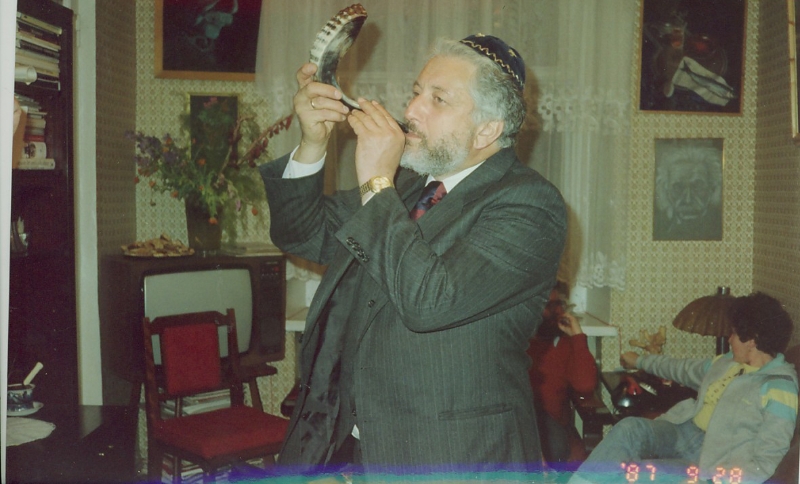
Vladimir Slepak blowing a shofar, 1987.
Interview with Vladimir Slepak. March 23, 2004.
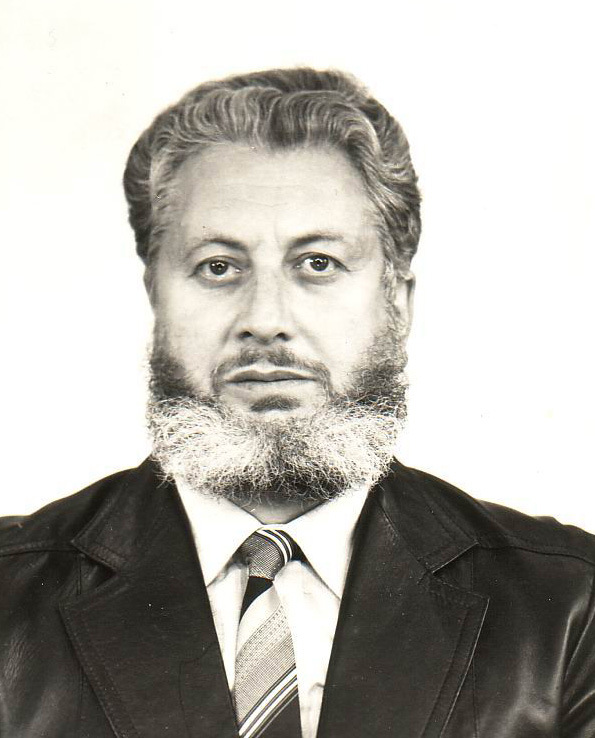
Yuli: Where, when and in which family were you born?
Vladimir: I was born on October 29, 1927 in Moscow. My Father at this time was a correspondent of TASS in Japan and China. When I was born, he came from Japan and when I was about two months old, we went to China. In China, I remained until the age of seven. Since my nanny was Chinese, my first language was Chinese. When my sister and I returned from China, my sister and I spoke Chinese for many years.
Y: Do you remember some Chinese up to now?
V: No. I can say only easy phrases… no more than that…
Y: And how did your father arrive in Moscow?
V: He has a long and very interesting story. By the way Chaim Potok has written a book about our family which is called The Gates of November. My father was from a village, Dubrovno, near Orsha in Byelorussia. He was a clever boy. His father was a melamed in a cheder and he wanted to make of his son, a Rabbi and after his bar mitzvah to send him to learn in a Yeshiva. But my father didn’t want it and ran away from home. My Father was born in 1893 and he ran away in 1906. He went to Orsha to a friend of the family and this friend arranged for him education in a real secondary school. When he graduated from this school, there was already the smell of war in the air… He didn’t want to fight and he moved to his sister in America who was living in Brooklyn since 1905. He learned there English, graduated three years of a medical institute and tried all kinds of jobs. He was selling dishes, working in a factory, washed skyscrapers… There he became very leftist… and when in Russia, the revolution began, he decided to return… America didn’t let immigrants return to Russia. There was a kind of agreement with a temporary bourgeois government, so he went to Canada to Vancouver and in Canada, he became the head of the professional units of Russian workers of Vancouver and in half a year, he succeeded to get to the Far East. At this time, the leader there was Kolchak, a white general. So my Father began revolutionary activities. They organized there an underground group and my Father was responsible for leaflets in English for American troops which were also, in the Far East then. Soon he was arrested, sentenced to the death penalty but on some jubilee of Kolchak, the shooting was replaced by forced labor for life. He was sentenced to forced labor to Sahalin. In Sahalin, his friend arrived and he succeeded to create links with the outside world and they organized an upheaval. As a result of this upheaval, he was released and became the first Chairman of the union of workers and soldiers, deputies of Sahalin. There he also entered the Communist Party but soon the Japanese began their offensive and they escaped to the continent and created partisan groups. To say it, briefly, he ended as a commander of the front of Far Eastern Republic. There was such a republic then. After the meeting with the Red Army, his soldiers were integrated into the army and he became the chief editor of Far Eastern newspaper called Pravda. Later he was sent as a deputy of Sahalin to the international organization, KOMINTERN. He arrived in Moscow and there they appointed him as a Deputy Head of the news department of KOMINTERN.
Y: In which year?
V: About 1920.
Y: Such a circle in seven years. Now he was a member of high level nomenclature.
V: It looks like this… After that he was sent to China… illegally… with American passport to release some member of KOMINTERN… We keep so far until now the picture of Sun Yat Sen. ON the photograph is written: To dear comrade Slepak in memory of our meetings.”
Y: Jewish fates…
S: Yes… After he returned to Moscow. He was proposed to go to Japan as a correspondent since he knew the Far East but it was only the cover since he received a mission to negotiate recognition of Soviet Russia by Japan. Ultimately he succeeded to get recognition. But the Japanese remembered him, his participation in the war against them and they were making their revenge… in Asiatic way… When my Mother gave birth to her first child, they have suffocated the baby with obstetrical pliers. After that my sister was born. She survived miraculously. Up to the age of five, she had dents from pliers… After that, the twins were born. They suffocated both of them. When my Mother was pregnant with me, she declared that she will give birth only in Russia. She returned to Moscow where I was happily born and after that my Father was sent on a mission to China.
Y: How did he meet the year 1937 when there were great purges?
V: Interesting question. In China I was infected by dysentery, a bad kind of dysentery. I was passing a restoration course in the German hospital where all diplomatic corps was getting treatment. On the roof of this hospital was a flag with swastikas and above the table of the nurse was Hitler’s portrait. It was the year 1933. Professor told him you should get him to Europe. Here he will die. In 1934 on my birthday, we returned to Moscow. Sometime afterwards, the whole staff of Russian Embassy and correspondent staff in Beijing was shot.
Y: So you have saved him with your illness?
V: Yes… Yes… I saved him twice. When we were moving to China, the train was intercepted by the band of Antonov. They killed all the Bolsheviks. My father and mother received mercy only because they had a nursing infant.
Y: Where did the shooting of the Embassy staff take place?
V: Somewhere in 1937. I don’t remember exactly… They were invited one by one to Moscow and there they were shot. The accusations against them were made after my father’s departure. So, they didn’t touch him… He was the deputy head of International TASS. The head of TASS committed suicide when he was accused of a serious crime. His own head, Berezin, was arrested and shot. This was the year 1937.
Y: KOMINTERN was in Moscow?
V: In Moscow. Later Stalin dispersed it. After that he was working in a closed institute which was listening to all radio broadcasting – foreign broadcasts and preparing reports for the Politboro. After that he was invited by Furtseva. She was then the head of the District Party Committee and said to him: We are now fighting cosmopolitanism. You should collect all papers about your activities in citizens war and we will try to get for you a personal pension. I can keep you no more than two months more.” It was the year 1949. Then all Jews were removed from ideological posts. He was fired from his job and a pension was arranged for him. Thanks to that as it appeared later, he escaped miraculously execution in TASS. After he left, TASS received a letter from CC of the CP with the demand to prepare compromising materials on certain people which were listed in the letter. The family name of my father was on the list in the first place. And those who already left, they didn’t look for.
Y: What did he do during the war?
V: He was working in Sovinform Bureau and later he became a member of the anti-fascist com. How he survived this period – I don’t really know… Miraculously…
Y: What are your maternal roots?
V: My grandfather on my maternal side was a Rabbi with family name Schur. It is in shtetl Kovno. In the Jewish Encylopedia, one can find this name. In this family during 40 generations, every elder son became a Rabbi. It was a tradition – Spain – Galicia – Germany , Byelorussia – but my uncle, eldest son of my Grandfather, violated this tradition… Instead of becoming a Rabbi, he went to Bolsheviks. I should say that G-d punished him. He didn’t have sons – only one daughter and by this, the line of Rabbis stopped/was brought to an abrupt halt. Like my father, he first emigrated to America and later returned as a Bolshevik.
Y: From which school did you graduate?
V: I didn’t graduate school. I returned from the evacuation in the Urals in seventh grade. We returned in 1943 from evacuation and I was in 7th grade. I was then 16 years old. What to do? I didn’t want to go to school. So I have found some extra-mural school where I could pass exams externally. So in two months I prepared myself and passed all the exams for 8th grade. After that I decided to go to Aviation Institute.
Y: With only 8th grade to an institute – not early?
V: All the institute did not have enough students because most people were at the front; so they accepted students for preparatory courses.
Y: How many years were needed in prepatory courses?
V: 1 year. Graduating exam was counted for acceptance to the Inst. In 1944 I was in the first grade of the institute and in 1950 I graduated from the inst. In the field of radio-electronics. After graduating, I was sent to Novosibirsk. But this was a climax of the fight against the cosmopolites. I was a Jew and I was abroad. They didn’t check which age I was abroad. So I was denied acceptance to the job. Then I was directed to one research institute. In Moscow – again denied the position. There were several guys like me so we were invited to the Dean of the Institute and told that we will do our diploma work in the inst. And after I defended my diploma, they said look for a job yourself. But in the SU there was no freedom to take a job according to the wishes of the student, a young engineer. So I should find the job to bring from this place the paper to the Institute that I was accepted and then they should give me the paper that they allegedly directed me there. I went through about 200 places. After all, I found a team which repaired TV sets and I was accepted there.
Y: What in your opinion was conception of authorities towards Jews at this time?
V: To light up anti-Semitism… later, according to their plan was The Doctors Plot and then deportation to the east. All directors of the plan had oral instructions not to employ Jews.
Y: How did you get to the plant of electronic lamps?
V: Listen. In the plant of electronic lamps. Many Jews assembled. The director of this plant, Mr. Svedkov was married to the daughter of Mr. Bulganin who was then, if I remember correctly, was the Prime Minister. Mr. Svedkov had an urgent contract with the State in the field of radio location. So Mr. Svedkov asked permission, even oral to employ Jews. He received it and all young engineers went there and more mature engineers who were fired from their posts went there. So I got there.
Y: There you became acquainted with Drapkin, Polsky, Prestin?
V: Prestin didn’t work there. His wife Lena did…. Yes every Sunday we were traveling together – skiing together, rubber boats, sometimes Russians joined our company but very quickly leave us; I don’t know why… In the beginning we never talked about Jews or Jewishness….and Jews stayed in the company of these travels. Somehow Jews consolidated in this company while non-Jews came and left…
Y: And gradually Jewish subjects appeared?
V: Via Drapkin – of course. His wife was from Riga. She graduated Jewish gymnasia and she grew up in a Jewish environment.
Y: This Riga phenomenon was.. after the war in which so many were exterminated.
V: Many succeeded to survive… and later returned there… They had a community… The thing that we didn’t have in Russia… We didn’t grow up in a Jewish community… and it made us cosmopolites.
Y: In Soviet meaning of this word?
V: In any meaning?
Y: In 1956 you were already almost 30 years old. The Sinai campaign somehow touched you?
V: Touched… First we went through this cosmpolitism… They very well made us feel that we are Jews. Secondarily, Masha was learning in a medical institute and in those years every second day they assembled a meeting and somebody from the party was lecturing about betrayal, disloyalty, and cosmopolitism. Then they took some Jewish professor who talked that we should be alerted because around us there may be enemies. Masha asked my father, a Bolshevik, what is going on? Many of my friends and teachers have been arrested. I know them. They are honest people. They aren’t adversaries. It was September-October of 1952 and people were being arrested already. My father said: “It might be it is possible that among those arrested, there might be honest people but it is better to arrest 100 people that have among them one enemy than to let this enemy bring damage to the whole society.” I was agitated by this and remember that I told him, “You know father I will never be in your party.” Too much blood on your hands. He began to shout at me… that I’m contra revolutionary… that I understand nothing…that I’m an idiot… It made the first breach between us.
Y: You were never in the party?
V: Never.
Y: And he stayed a Bolshevik until the end?
V: I don’t know… These questions are still open… When I was arrested he wasn’t in Moscow. He didn’t know that I was arrested. You know he broke relations with us when we decided to immigrate to Israel and I told him about it. It was a terrible scandal. It was in 1968 when the first guys from Riga began to go to Israel.
Y: And he didn’t give you his affidavit for OVIR?
V: Never… Even not close to that… I told him write that you are against. He said I will write nothing and that’s it… and said he will do everything in his power to see that we are refused… OVIR accepted our papers without his affidavit.
Y: He have eaten so much shit by himself. What do you think is the reason for such an approach?
V: It was like a faith, a religion. Can you prove to somebody who believes in G-d that there is no G-d?
Y: Maybe it’s injuries he received as a new immigrant in the US… Talented guy… worked in a very taxing and humiliating jobs…
V: Nothing of the kind. He was studying in university at night… If the revolution would have happened two years later, he would have gotten a diploma as a physician.
Y: But to his own kids…
V: Yeah… If a kid denies his religion… t’s the same… and he broke all relations with us, married another woman and went to live with her.
Y: He was 74 years old? He was healthy enough?
V: Yes. He worked as a loader in the docks of Vancouver. He had broken relations with us. He wasn’t foreign to me. I learned about him through my cousin, my father’s nephew. When I was arrested, I was first sitting in Butirka Prison. The authorities sent me to my first place in exile in the beginning of August. Travel continued for one month. In the beginning of September I arrived in Tsokto-Khangil and very soon Masha informed me that my father died and she received permission for me to attend the funeral. There I have learned that when my Father returned to Moscow and was told that I had been arrested, he went to the corner of the room, sat down on the sofa and was sitting on this sofa swinging back and forth and murmured something in an unknown language. His second wife who told about this incident was Russian and she didn’t know this language. He didn’t eat, only drank water and in three days he died from a heart attack. All three days he was sitting on the sofa. It was his second heart attack. When he had the first one, I tried to visit him but he asked me immediately – have you changed your decision? I said no. Then go away… I don’t want to see you until you have changed your decision.
Y: He went through so many scary difficulties… So many people he worked with were shot… Was he afraid himself?
V: Yes. We were living on the second floor. On the first floor there was a post office. The KGB was going to take someone, they were passing by the doors of our apt. and I have seen him several times at night standing near the door and listening. Will they pass by or arrest him?
Y: Let’s return to your group in the plant.
V: Yes. My first turning point was in the time of the Doctor’s Plot. I understood that something is wrong in this country – a sick society… No more than that… I was 25 then and I was a zealous member of Komsomol.
Y: And about your Mother, you’ve told nothing?
V: She was a housewife. She was not involved in politics at all. There was no Zionism at the time.
Y: And 1956?
V: It was interesting but no more than that… But the 6 Day War – it was already a turning point in my life. Here I already understood that somehow I should get there… But in my position, it was hardly accessible… and may stay as a blue dream for the whole life… From 1962, I was working as a general constructor of a important part of control system for commanding centers of anti-air defense.
Y: How long did you work as a chief developer?
V: Up to when I left – in 1969.
Y: And in 1970 – you already submitted documents to OVIR?
V: Impudent, yes (laughs)
Y: To brave somehow… What kind of access to secrecy did you have?
V: First degree… I was a member of State’s commission for accepting anti-air and anti-rocket systems. The head of the Commission was Colonial General Tseganov. He was the chief of staff for anti-air defense for the country.
Y: Was your system good?
V: Outdated of course. Later we have understood it.
Y: You applied for an exit visa to Israel before Polsky, Prestin and Abramovich?
V: Yes, much before… But there were people before me… Villi Svichinsky, David Khafkin, Tina Borodetskaya.
Y: You were general director of systems development. One should be a bit crazy to apply for an exit visa so soon.
V: I was a bit crazy. I left the work with access to secrecy and found a place in a geo-physical trust with the help of Volodya Prestin.
Y: Once more – when did you decide to go?
V: I didn’t know how to do it. Suddenly they said to me do you want to meet with a person for Riga who is leaving for Israel. Of course, I wanted to meet this person. I have met with Mark Lapid. It was November – December 1968.
Y: You decided to go and immediately request an invitation from Israel?
V: Yes… No… I knew that it was necessary to do something before departure… So were meeting, discussing all that… Together with Khafkin, we multiplied Hebrew textbooks.
Y: When?
V: 1968-1969. We photographed them and printed them. We rented in Moscow a one room apartment for these purposes. We also, multiplied the newspaper from Riga called Iton.
Y: Polsky and Prestin translated Exodus?
V: Yes they multiplied it on a typewriter. Later Izya Shmeller called from Novasibirsk and told me that he had found in one storehouse sixty dictionaries of Schapira. “Do you need them?” I said, “urgently”!!! “OK but where to get money for it?” “How much do you need? We’ll assemble money.” So we assembled money, sent to him and got the dictionaries.
Y: How did you organize your life in refusal in the beginning?
V: Wait… For a long time, they didn’t accept my documents. Characteristic from my place of work was useless to request. My Father won’t give an affidavit. So I changed jobs and we together with Volodya Prestin were working there. Well after that we applied and I hoped that somehow we would break through.
Y: In two or three months?
V: I knew it would be more than a year but I thought the earlier I would apply… you know…earlier you will be arrested, the earlier you would be free… (the proverb of refuseniks)
Y: How did it happen that your apartment became very quickly the most visited apartment in Moscow?
V: First of all, location. It was very close to hotels where foreigners were staying. They were arriving at night, threw their suitcases and were coming to me – at 3 o’clock at night, 4 o’clock.
Y: How did Masha stand it?
V: She stood it… Further, English was quite awkward but I didn’t have to learn it. I needed to remember it. You remember I was studying in an American school in Beijing.
Y: You quickly began to speak English quite well?
V: Yes…
Y: OK. Foreigners have found you very quickly and what about activities inside the aliya movement?
V: Inside, maybe thanks to my impudence and secondly because my English I was a link to correspondents.
Y: You were disbursing around you an atmosphere of fearlessness?… here, Slepak is our Yakir.
V: Yakir was broken down.
Y: It was later… We are talking about earlier times…
V: I visited him.
Y: Did you have any relationship with dissidents before applying for an exit visa?
V: Villie Svichinsky acquainted me with them.
Y: Were you sympathetic to them?
V: Yes
Y: Were you ready to take part in their activities?
V: Yes I was… but with intention to immigrate…
Y: Did you feel any contradiction… you want to reform the country from which you want to leave?
V: In any case I wanted to reform this country… At least in the immigrational field. This was a fundamental question for me.
Y: But dissidents have seen it much wider – democracy, human rights.
V: I was not against democracy and human rights… I’m not against it now and then it didn’t repulse me.
Y: Even before a Jew awakened in you, there was already a housed dissident.
V: After I understood this was a sick society – in the Doctor’s Plot and after I understood that we have our own country Israel, this was after the 6 Day War… When we began, it was clear to us that we are isolated in our own circle and that we should find an exit to outside. We needed somehow to get in touch with Israel but there was no Israeli Embassy… Besides, I already knew that American organizations were also, struggling for our release…
Y: From where did you know this information?
V: This from dissidents.
Y: Dissidents understood first that winds of a Cold War blew in their sails. He has given this knowledge to Jews and you began to establish independent links with abroad.
V: First, I began to give the information to the dissidents with the request to transmit it to the foreign correspondents in order to pass it to the West. Later came to me Volodya Bukovsky and said look I have behind me such a strong tail… I feel they will arrest me very soon. He brought with him two correspondents from UPI and from Reuters. You will be in touch with them directly. We spent three hours to get rid of the KGB tails. Bukovsky was really arrested in two days and me too, the day before his arrest. I was sentenced to only 15 days. They took me near my home after the meeting with the correspondents. My son, Sanya, next day went to tell Bukovsky that I was arrested the next day. The apartment of Bukovsky was, of course, bugged so Sanya wrote to him on a magic slate… All of a sudden, the doors swung open and KGB blew in. The KGB immediately went for the magic slate but Sanya managed to wipe it off… so they detained it at the police station, kept there several hours and released. Bukovsky was arrested on this day.
Y: When were you acquainted with Sharansky?
V: I think it was in 1972. He joined first a group of so-called hooligans who were organizing demonstrations and later came to me.
Y: Who introduced Alec Goldfarb?
V: Alec had very good English and when we organized press conferences or invited correspondents, he was the translator.
Y: You introduced him to it?
V: No.
Y: And who?
V: I don’t remember.
Y: After Alec Goldfard was Volodya Kozlovsky and after K, Sharansky became the speaker and translator?
V: NO. After Goldfarb, was Sharansky. K was never the spokesman. Transmission of business, as I remember was at Kyrill Khenkin.
Y: After Goldfarb, Tolya was near you?
V: Not only near me. I introduced him to Sakharov and he was translating for him as well.
Y: You together entered the Helsinki group.
V: No. I didn’t in the beginning. I did when Vitaly Rubin got permission to go and I replaced him. Tolya [there] was from the very beginning.
Y: Activities began, visits to governmental bodies, demonstration at the Central Telegraph etc. Who in your opinion emerged at this time as a leader or leaders?
V: A question is that we have an iron agreement. There are no leaders. We can advise each other, help each other, exchange information. A person can accept advice or not accept advice. Our communication was only at that level. No leadership. No orders. We are not an organization. Leningrad and Riga trials have taught us a lesson.
Y: Some Jewish activists refused to cooperate with dissidents. Israel pressed not to cooperate…
V: And how!
Y: Someone tried to put pressure on you?
V: Guys from National Conference have informed me secretly that Nehemia Levanon said about me: “his arrival to Israel is undesirable.”
Y: Why?
V: Because they all the time were nudging/pushed us from Israel that we should behave quietly and the last straw that broke the camel’s back was the Jackson Amendment which we with Kyrill Khenkin initiated. Kyrill, at some point, was a Soviet spy in the West. Then he returned and became a dissident.
Y: Was he a Jew?
V: Half. His father was an opera singer in Paris and his Mother was a Russian princess from immigrants… He graduated Sorbonne.
Y: As to the initiative of Jackson to link immigration and most favored nation’s status, there are some who say it to a Brainstorming group of Jewish professionals in Washington including Jerry Goodman.
V: I know Jerry pretty well. This is a bird of a different color. It’s not level.
Y: He was General Director of National Conference.
V: He was at some point…
Y: This idea of yours and Khenkin, you proposed to Americans. How did you formulate it?
V: The idea was to link immigration with economic interests… Nothing more. In the beginning, there was a naked idea. Lou Rosenblum from the Union of Councils accepted this idea. He was a professor from NASA.
Y: You were looking for a painful points of Soviet regime and came to the conclusion that it is necessary to press via economics?
V: Yes. We expressed it to Lou Rosenbloom and later we learned that Jackson initiated this amendment.
Y: When did you propose this idea?
V: Some time in 1973… The amendment was passed quite quickly in America.
Y: Did Sharansky take part in the discussion and the amendment? I have the impression from communication with him that he played an active role in the development of this idea.
V: At some stage, Kyrill and I assembled 5-6 people of ours and discussed it… He was among them… He was not from the beginning… The main initiator was Khenkin. I was the first to hear it from him and I supported the idea with both hands and I began to see how to arrange to link him to Lou.
Y: He had links with correspondents. (Khenkin)
V: Easy.
Y: But he was interested in links with Jewish organizations. How did he see himself as a dissident or as a Jew?
V: He wanted to emigrate as a Jew.
Y: I remember that. He left on a Jewish visa.
V: He lived in Israel for a certain period but he was squeezed out from here.
Y: When did the pressure on you not to maintain common activities with dissidents began and in which form did it express itself?
V: All the time. When we were transmitting information to Israel by phone… Since 1973, I have a connection with Nativ. You remember there were difficulties with telephone lines. They disconnect our telephones… so what did we do? A person is leaving and leaves us the keys from his apartment… When the Jackson Amendment appeared in the US, there was a group that was against it. I don’t remember exactly whether the amendment had passed already and they were fighting its cancellation or whether it hadn’t passed and they were fighting the process… the second initiator of this amendment came to us and pleaded with us to write that we are against this amendment. Somebody misguided him. Jackson stood firmly and Vanik had broken…
Y: Jackson was the son of immigrants from Norway. He himself experienced many obstacles and probably better understood and was sensitive to our situation…
V: And they pressed us all the time from Israel and when we were told that Levanon himself considered it was necessary to behave quietly and will draw us out with the methods of quiet diplomacy, I couldn’t keep my temper and said by phone to Israel that if Levanon supports this ideology, he should be expelled from ruling this organization… I didn’t know then what kind of organization it was…
Y: Yes… maybe they understood quickly that you are very difficult to control… that you are unmanageable person… Did they support you materially?
V: It was… Americans not Israelis…
Y: Polsky got support.
V: I know…
Y: They didn’t succeed to change your opinion, not on the question of the amendment and not on the question of dissidents.
V: Above all they made me crazy with the Jackson Amendment, of course. They demanded that we would make a stand against it.
Y: As I can remember, nobody from us took a stand against it.
V: Nobody.
Y: How can you explain their position at that time now?
V: They wanted to come to terms with Russia. They were ideologically close to them… socialists… When I arrived here and I’ve seen on the building of Histadrut red flags, I felt bad. They were sure that they will succeed somehow to reach an agreement and to take us out quietly without unnecessary noise…
Y: In spite of the fact that diplomatic relations were broken, that Soviets pumped Arabs with weapons, trained Palestinians the techniques of terrorist activities?
V: Yes… they were sure… Why not?… They belonged together… not at once, maybe in a year or more… they will try to prove to the Soviets… We were told that Levanon every year was visiting, it seems Hungary and was meeting there with KGB representatives for secret negotiations…
Y: KGB used Jewish immigration for his operative goals for sending to the West its agents…
V: I can tell you an interesting fact on this subject. A young guy shuffled around near the synagogue. I don’t even remember his name. One day he came to me trembling from fear and almost crying. He told me his story. He was in 10th grade in school and decided to go to Israel. He was taken to KGB, pressured like they know to do and said to him, if you want to go, sign this paper and if you won’t do so, we will destroy you. You won’t be able to receive a higher education, you won’t be able to take a real job. You will rot all your life as a blue collar worker, an unskilled laborer… You know that we can do it… and if you will sign it that your task will be to let somebody to spend the night in your apartment or to bring to someone some envelope. That’s all. If you are ready, in 2 weeks you’ll get permission and they pressed him and pressed him… He was still a kid… and he signed this paper. What to do? I told him if you get permission, go! Don’t be afraid. As soon as you arrive go to Shin Bet – the earlier the better. Every lost day will work against you. If you can’t find the way to Shin Bet yourself, here take the address and tell him everything and he’ll help you. The moment you will find your way there, send me a postcard and say that in Jerusalem is excellent weather. I gave him the address of Villi Svichinsky. In a month and a half, I am getting a postcard from Jerusalem, “ In Jerusalem the sun is shining and the weather is excellent”. I never saw this guy again. I can only imagine of their own agents that they have sent…
Y: Did you study Hebrew with someone?
V: I tried in Moscow. I began with Chava Mikhaelovna… She was at some point an actress with Habima. When Habima left, she was pregnant. So she was stuck here. I became acquainted at her apartment with these guys… Hijackers…
Y: You learned Hebrew before the hijackers trial.
V: Yes.
Y: Were you involved in the trial?
V: When the so-called hijackers were arrested, I had the first search in my house on the same day.
Y: In which year were you acquainted with them?
V: In 1969.
Y: Did they try to engage you?
V: We didn’t talk about it.
Y: With whom have you met from that group?
V: I don’t remember exactly… With Edik…
Y: On which pretext did they link you to this process?
V: On the case of Murzhenko… I didn’t know who is Murzhenko.
Y: There was such a period when Luntz initiated visits to KGB.
V: It was.
Y: And only you and Lerner allegedly knew about it?
V: Yes – it might be… I was against it from the very beginning…
Y: On this subject, another group of activists split aliya… Reason – secret visits to KGB – tries to reach an agreement… Micha Chlenov described it as a time of great split.
V: It was. There was dissent. There was a split. But not on that subject. This was pushed in additionally… I was categorically against these visits… It doesn’t mean that I stopped respecting Luntz and so on…
Y: And Lerner was for or against?
V: He was for…
Y: What was Luntz’s idea?
V: That maybe we’ll find some kind of contact….
Y: But it is according to you the policy of Levanon – to come to an understanding…
V: Luntz was much tougher. He, in general, is a very tough fellow.
Y: But he didn’t succeed.
V: And the split was because a group of Polsky and others insisted that one shouldn’t drive the bear into the corner and it’s necessary to engage in Jewish culture, enlighten people, learn Hebrew…
Y: Tarbutniks (Promoting Jewish culture) and politicians, yes?
V: Ohhh… and not to thrust into politics.
Y: Were they against the Jackson-Vanik Amendment?
V: They were for it! They claimed that it isn’t necessary to actively campaign for it – not to speak about it too loudly – not actively demonstrate for it
Y: Namely, that Americans will push it through and we shouldn’t campaign…
V: Yes… We can say that we are for…
Y: And what did you propose?
V: To organize demonstrations, hunger strikes, meetings with Congressmen, Senators etc.
Y: Nativ, of course, was not of your side.
V: Of course… The second important point of the split was if all are obliged to go to Israel.
Y: What was your position?
V: I was saying when a person crosses the boundaries of the Soviet Union, he became a free man. He has all the rights to choose for him the place of his country of residence by himself.
Y: You were closer to a democratic approach?
V: Another group – to drive them only to Israel.
Y: It was my position too. Now, I’m a little bit softer but just a little bit.
V: It’s another matter that you can agitate for Israel, speak for Israel. You can say you don’t want to be in touch with the person who isn’t going there. You can say… but publicly speak that the Americans won’t let them in and that all should go only to Israel – you must not… forbidden to talk this way.
Y: The question was different. The argument was that when one goes with an Israeli visa to some other country, he demonstrated to the whole world in Vienna that it was a false invitation and false struggle for re-unification of families and this undermined the chances of all those who did want to go to Israel on an Israeli visa.
V: No… To compare with what Soviets did. It was such a trifle…
Y: But the reality who was giving permission were the Soviets.
V: All the more so…
Y: It means that you were ready to risk the prospects of aliya…
V: Not the prospects for aliya… If a person wants to go to America…
Y: Then let him apply to America and break his way through.. Why necessarily jeopardize chances on aliya to Israel?
V: Why not to give him help?
Y: Because, it undermines the chances of aliya to Israel.
V: Why undermines?
Y: The argumentation was precise enough… First, Aliya to Israel is the call of blood. It is the reunification of the families. It’s repatriation, after all – this the Soviets could explain decently. And any other Jewish immigration was an escape from the Communist paradise for the happy future of all humanity, which undermined the very basics of Soviet propaganda in the capitalist countries and in the Soviet block.
V: This was an open lie and against this lie we could allow to ourselves a little lie.
Y: But the reasoning was that since emigration to anywhere so explicitly undermines a frank deception of Soviet propaganda, it was especially painful for the authorities and it could drive them to oppress immigration to Israel.
V: They were limiting emigration to Israel so long, as they have such an ability. They were pressing all the time… They couldn’t do it stronger… It’s like today people are talking about Yassin killing…
Y: That it will provoke additional terror?…
V: Yeș… what additional? How much more can they?… They were blaming aliya as they only could…
Y: There was another point of view that in 1973-1975 doors were really open for emigration. And the proof was that the number of refuseniks didn’t grow – in 1973-1975 which means that people with Zionist motivation who went through the campaigns of ruthless cosmopolites, difficulties with employment, anti-Semitism, have left already. Further, it is necessary to educate this motivation. These were arguments of cultural people.
V: Two years passed and the number of refuseniks increased. These are fluctuations.
Y: It’s scarcely fluctuations… When the authorities opened the doors on the level of 50,000 a year, they quickly enough got free from the people who were ready.
V: Others were not ready yet… but it doesn’t mean that cultural activities forced them to change their opinion. Some were waiting a year until their son graduated the institute. Another one had kids married and difficulties with relatives emerged…
Y: You want to say that cultural activities didn’t play any substantial role for motivation of aliya.
V: Cultural activities were necessary… but it shouldn’t be the only activities… Cultural activities should be done against the background of all those who tried to open doors as is necessary.
Y: You don’t think the doors were open?
V: No. No.
Y: What produced the feeling that the doors are closed?
V: There were many common refusals – refusals based on army service, higher education, anti-Zionist propaganda, constant trials, the approval of relatives remaining in the Soviet Union… whatever…
Y: You mean the level of fear was high enough for Jews to risk jumping over it?
V: Yes.
Y: The circle of refuseniks was big enough and visual enough and the authorities persecuted them painfully enough that others wouldn’t wish to risk get in this circle.
V: Yes. Yes.
Y: So you mean these factors were restraining people and culture doesn’t relate to it. Culture works very slowly…
V: Yes… We never said that culture isn’t necessary…
Y: And was there a possibility to talk in terms of “we’ll give the Jews culture”
V: It was… When I learned literally two-three lessons of Elef Milim, I assembled my relatives and began to teach.
Y: Let us see the proportions… Two hundred refuseniks…All of them started to teach Hebrew… How many people can they reach?
V: That’s the case.
Y: Two –three hundred copies of some journal… Could this allow to us to talk about a culture for 2 million?
V: Possible… It is like a crystallization… There should be points from which it begins and later it begin to grow… many years…
Y: Tens of years…
V: And we were saying this… that we should open the doors… Khafkin said once “everyone takes upon himself as much as he can bear but one shouldn’t reprove a person who took upon himself a little”. Essas played bad service to this split…
Y: Which one?
V: He began to say that all these telephone conversations with abroad we do ourselves and do not invite cultural activists, that it is deformity that cultural activists should also, have their own links. We say to him so establish it and he said how can we establish it if you have a monopoly in your hands?
Y: It means that in your group there were more links with the West and a kind of jealousy appeared…
V: Yes. It was an idiotic argument that we don’t invite them them entry into telephone communication.
Y: To summarize the opposing position of say, provisionally cultural activists and political activists, you didn’t speak against culture but thought that culture cannot replace a serious political struggle for emigration.
V: Yes.. Yes.. Yes..
Y: And the Helsinki group – you engaged only in emigrational matters?
V: Among the materials of Helsinki group, I signed only the documents on the problems of freedom of emigration or anti-Semitism. Members of the group knew my position.